Research
How a brush lays paint
Our first strokes were even tubes of color: straight edges, the same thickness from end to end, a round blob where they started and stopped. Real brush marks are nothing like that. What makes them look like paint, and how do we get there without stamping a picture of one?
What a real mark has
Look closely at any oil stroke and the same things show up:
- Hairs. Even a solid stroke carries fine grooves along its length, one for each group of hairs, and those groups merge and part as the brush travels.
- A life story. A loaded brush lays a dense, opaque body; as it empties, streaks open up, then the paint breaks over the canvas grain, and the last of it is single hairs.
- Ragged edges and ends. The outer hairs splay and wander; the hairs touch down and lift off at slightly different moments.
- Response. A slow, heavy stroke is full and solid; a quick one parts into streaks; a light touch only skims the tops of the weave. Turning, the head drags round the corner.
- Paint that moves. Drawn through wet color, a brush picks it up and carries it on, so white pulled through blue trails a blue-white mix.
What Enogu does
Every mark comes out of the brush, the paint it carries and the canvas, not out of a stored picture. The brush is a bundle of simulated hairs, each holding its own paint. As a stroke goes:
- Touching down is the dip. The hairs take about a dip's worth of paint, joining whatever they still carry, so a color the brush went through tints the next stroke or two.
- The paint runs out. A dip lays a solid, satin body for about ten brush-widths; then streaks open along the stroke, and the last of the paint trails off as dry-brush, catching only the high points of the linen in fine specks.
- The hairs gather into clumps that drift, merge and part with the distance painted; a loaded head is one body of paint, and the clumps show as it empties.
- Speed and pressure change the structure, not the opacity: quick strokes splay and skip, pressing gathers the hairs into a fuller footprint, and a light touch skims the weave so the canvas shows through.
- The head has a little memory: at a turn it swings round over a short distance, so corners drag and fan out.
- Starts and ends are a brush's own: a flat starts square and a little ragged, a round starts domed, and nothing curls into a hook, lands as a blob or ends in a row of dots.
- Brushes pick up the wet paint they cross and lay it further on, and the knife chatters, frays at its ends and skips as it runs low.
Each brush has its own settings, so the stiff bright scrubs, the fan and comb split into strands, the soft mop blends, the stippler dabs and speckles, and the rigger keeps a clean line.

Why every stroke was a ribbon
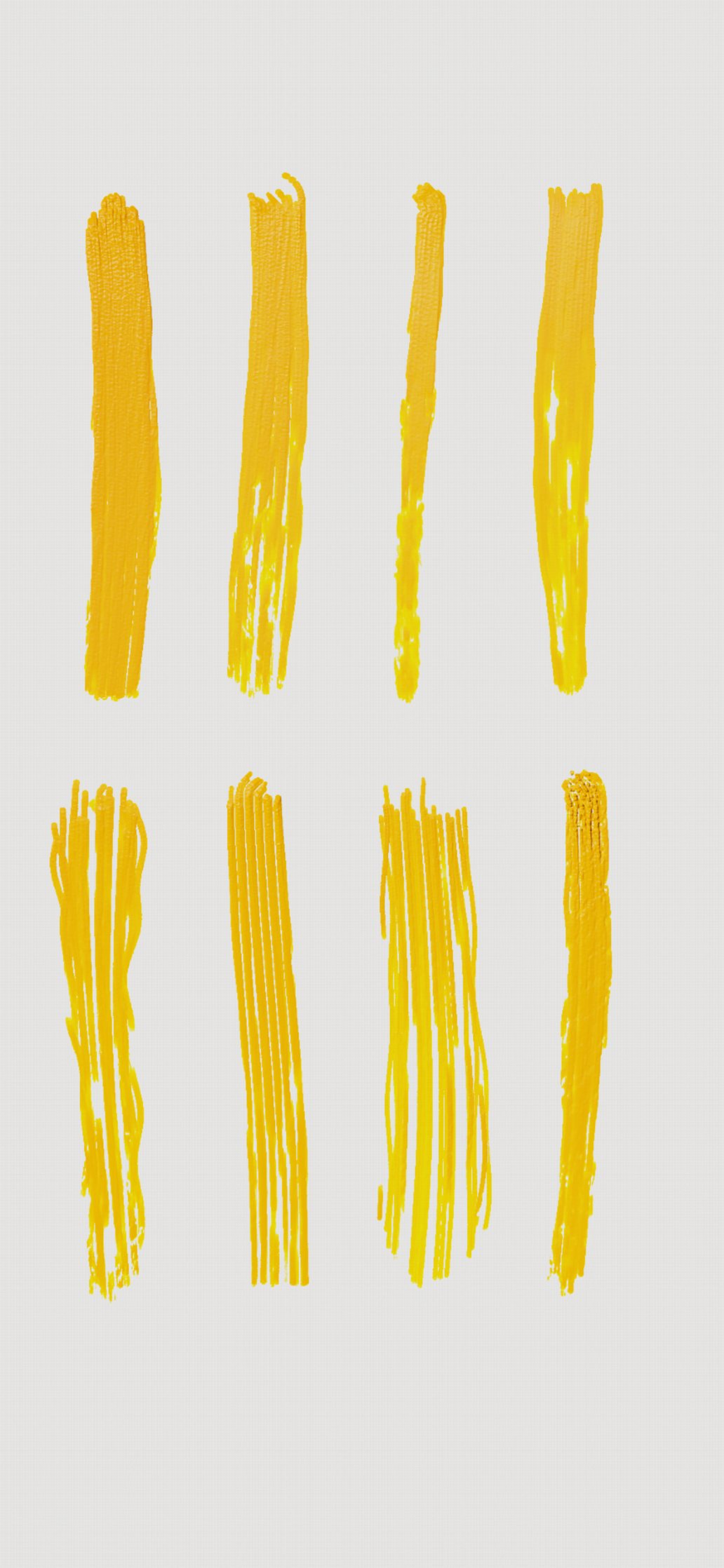
For a while each stroke came out as an even ribbon, the same width and thickness from start to end, however much paint the brush took. The reason was in how a hair hands over its paint. When a hair couldn't fill the film under it, it gave half of what it carried, every step. Its paint halved, and halved again: whatever the dip, it was spent within a few steps, and only the paint pushed up from deeper in the brush kept the stroke going, as an even ribbon with a bumpy start.
Now a hair lays at most a set share of a dip each step, so a loaded brush spreads a lean film and a dip lasts its length; below about 40% of a dip, that share shrinks with what's left, so the stroke fades out instead of stopping dead. A nearly spent hair doesn't spread a trace too thin to see: it puts its last paint on the spots that stand proud, in streaks along the stroke. Brushes lay only the paint on their hairs, so there's no bumpy deposit from deep in the head.
The test suite
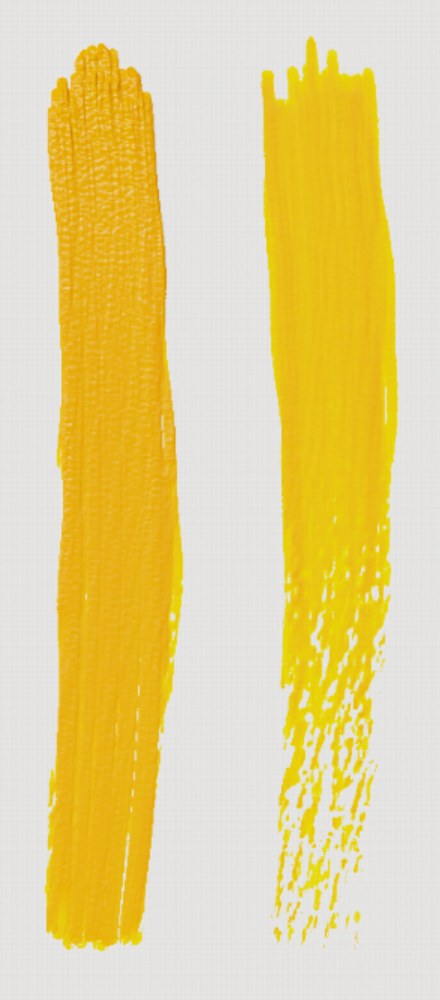
Every change is judged first on real finger strokes in the app, as on the sheets above, and then on the same seven scripted strokes for each brush, not on a single picture: loaded and slow (dense, a little hair); loaded and fast (streaks); one long stroke until dry; white through wet blue (pickup); changes of direction; yellow worked over wet red (mixing); and light pressure (the canvas showing).
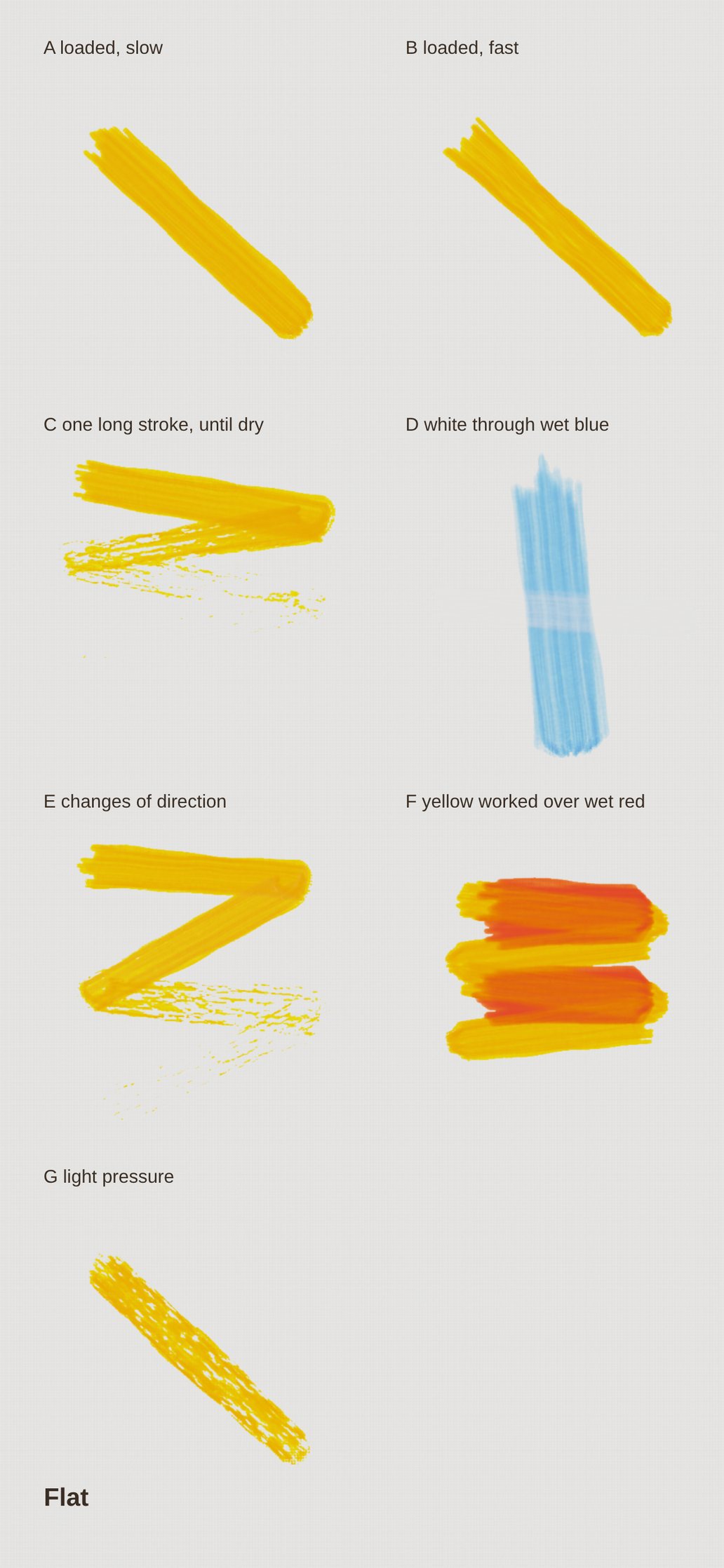

The aim is marks people play with because they respond: slow and fast, light and heavy, loaded and spent, wet and dry should each feel different under the finger.